
1

An event starts the workflow
A system, device, user, schedule, API, or operational condition signals that something happened.
Example: fleet.vehicle.criticalFaultDetected
 ASSIST
ASSIST turns an event into a governed operational response.
It gathers context, applies policies, decides what should happen, coordinates the right people and systems, tracks execution, and records the outcome.
Event
Something happens Context
Understand the situation
Context
Understand the situation Policy
Apply rules & approvals
Decision
Determine what happens next
Policy
Apply rules & approvals
Decision
Determine what happens next Action
Coordinate systems & people
Action
Coordinate systems & people Evidence
Record the outcome
Evidence
Record the outcomeEvery ASSIST workflow follows the same basic pattern. The details vary by operation, but the control model remains consistent.
A system, device, user, schedule, API, or operational condition signals that something happened.
ASSIST retrieves the information the workflow needs before making a decision.
Business rules, security requirements, approvals, and operational constraints are evaluated.

ASSIST can continue automatically, request human approval, branch, wait, retry, escalate, or stop.
ASSIST executes the required actions in the right order and sends work to the right participants.
ASSIST records what happened, what decisions were made, which policies were applied, and what actions completed.
One real scenario, start to finish — the event, the context ASSIST gathers, the policy it applies, how it coordinates FleetOps, dispatch and maintenance, when a human gets pulled in, and what gets recorded.
A vehicle reports a critical fault.
What ASSIST receives:
ASSIST does not blindly react to an event. It asks:
The critical-fault policy requires the vehicle to be removed from service.
ASSIST is not the thing that detected the fault — it's the thing coordinating what happens because of it.
ASSIST is not the thing detecting the fault. It is the thing coordinating what happens because of the fault.
Does this require approval?
Continue automatically.
Pause → request manager approval → continue when approved.
Execution progress:
ASSIST keeps one record of the entire response.
ASSIST separates what can happen automatically from what should require policy checks, approvals, or human judgment.

Routine, policy-approved actions can execute without waiting for a person.

ASSIST pauses the workflow and routes the decision to the right role or person.

Timeouts, failures, missing data, or operational exceptions can trigger alternate paths.

Every significant event, policy evaluation, decision, and action remains traceable.
ASSIST is not limited to system-to-system automation. A workflow can execute actions automatically, pause for input, assign work, wait for an external event, then continue from the same execution.
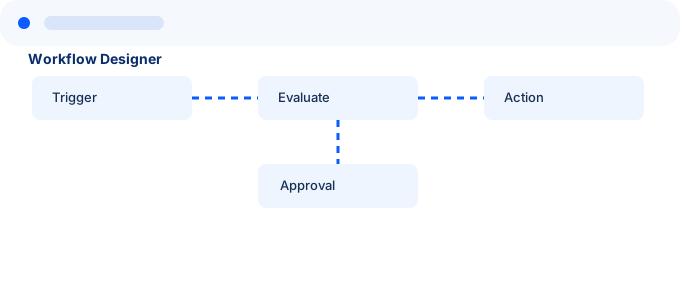
Design it, activate it, observe it, and inspect every execution from the same governed platform.
Explore the product overview, or talk with us about where orchestration fits into your operations.